Signal Isolation & Faraday Bags
How Faraday Shielding Works
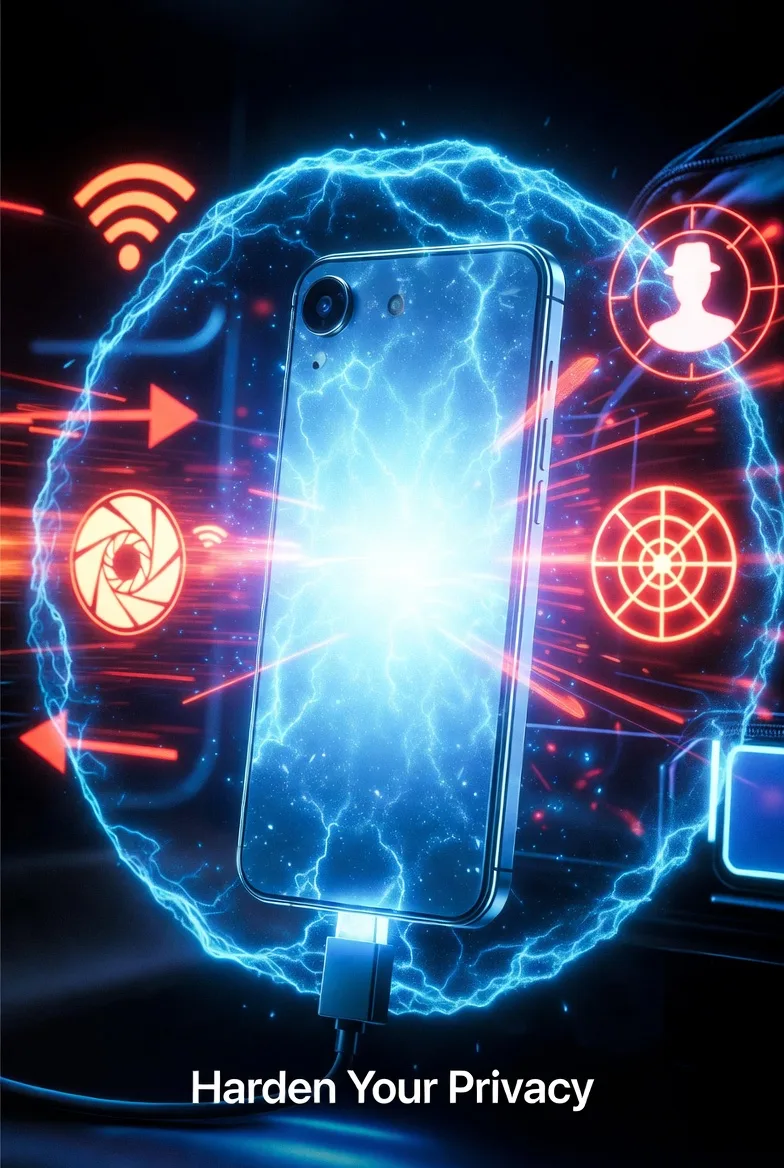
A Faraday cage is a conductive enclosure that blocks external electric fields by redistributing charges along the enclosure's surface. Any signal outside the cage is attenuated or blocked before it reaches the contents. A Faraday bag applies the same physics to a portable mesh pouch. When the bag is properly sealed, signals from Wi-Fi, cellular, GPS, Bluetooth, NFC, and RFID cannot enter or leave.
What Faraday Bags Block
A quality Faraday bag blocks the full spectrum of radio frequencies used by consumer electronics: cellular 600 MHz through 6 GHz (5G), Wi-Fi 2.4 and 5 GHz, Bluetooth 2.4 GHz, GPS 1.2 and 1.5 GHz, NFC 13.56 MHz, and RFID at the 13.56 MHz, 125 kHz, and UHF bands. The bag does not block wired signals; a phone with a USB cable plugged in while inside the bag can still transmit over that cable.
Keyless Entry Relay Attack Defense
The most common consumer use for Faraday pouches is blocking keyless-entry car fobs from being captured by relay-attack equipment. Thieves use signal amplifiers to relay the fob's signal from inside a house to the car parked outside, unlocking and starting it. A Faraday pouch at the front door blocks the fob's signal and defeats the attack. This is a real and rising threat in some regions.
Forensic and Investigation Use
Law enforcement and private investigators use Faraday bags to preserve phones in an evidentiary state. Once a phone is placed in a Faraday bag, it cannot receive remote-wipe commands, cannot be located, and cannot participate in the cellular network. This is essential in digital forensics — most modern phones will remote-wipe on command, and an investigator who does not bag the phone immediately may lose evidence.
Travel and Border Privacy
Some travelers use Faraday bags to control device connectivity at borders or in high-surveillance environments. The bag prevents background syncing, location reporting, and remote command execution while the phone is in transit. This is a legitimate privacy use case for journalists, attorneys, and others with professional confidentiality requirements. It is not a magic solution — border agents can still require the phone to be powered on and unlocked for inspection.
What Faraday Bags Do Not Do
Faraday bags do not block acoustic signals, do not block wired network traffic (Ethernet or USB), do not prevent local storage tampering, do not defeat malware already running on the device, and do not prevent a compromised app from capturing data the next time the phone reconnects. They block RF signal in and out — nothing more, nothing less.
Buying a Faraday Bag
Quality Faraday bags cost $25–$80 depending on size and shielding specification. Look for bags that publish signal attenuation specs (typically measured in dB) across multiple frequency bands. Higher dB attenuation is better; 60+ dB across the RF spectrum is professional-grade. Cheap fabric pouches that do not publish attenuation specs may or may not work; test with an actual call to the enclosed phone before relying on them.
DIY Faraday Enclosures
A sealed aluminum-foil wrap will block most signals if applied carefully. A metal ammo box or sealed metal lunch tin will also work. DIY enclosures are not as reliable as purpose-built Faraday bags because the seal around openings is imperfect, but they are sufficient for most casual use. Test any DIY enclosure by calling the phone placed inside — if the call goes straight to voicemail, the enclosure is working.
More Guides
- 25 Phone Hacks Everyone Should Know
- Android Developer Mode Guide
- Android Debloating Without Root
- 30 Hidden iPhone Features
- Privacy Hardening Guide
- Carrier Unlock Codes
- Signal Isolation & Faraday Bags
- ADB Commands Reference
- Battery Optimization Guide
- Phone Security Basics
- Juice Jacking & Public Charging
Legal & Safety Disclaimer
All information on Hack Any Phone is for educational purposes only. Modifying your device can void warranties or cause instability. Always back up your data. We do not condone illegal activities such as IMEI changing or unauthorized network unlocking.